
Baton Rouge lives on the banks of the Mississippi, in a heavy, almost liquid light. Barges move up the river, refineries draw industrial silhouettes at night, and the streets come alive to the rhythm of jazz, Creole cooking and endless summers. It is a city where history has left visible layers, like paint that never quite dries.
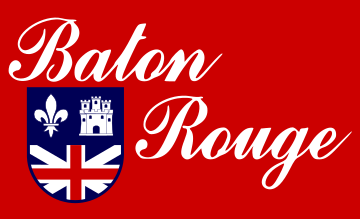
Baton Rouge's flag reflects this complexity: on a red field, the city's name in white script and a shield divided in three, the fleur-de-lis of France, the castle of Castile, the British Union Jack. Few American cities have seen so many changes of sovereignty, language and culture. The flag carries these traces like a patchwork of identities.
You find old neighborhoods, rougher streets, official buildings, bars where music spills onto the sidewalks, bustling markets, and the ever-present river.
Flying above an elegant Capitol that dominates the skyline, the flag symbolizes this multiple city, colonial, American, Louisianan, that has learned to make history, heat and the energy of a people who live intensely coexist.